Miscellanea is the newsletter for the independent thinker, at the intersection of digital content, knowledge management and culture. In this edition, we have writing advice from Umberto Eco, a jazz album, and 5 ways to organise information.
Edition No 16. Date: 1 September 026
If you like this newsletter, please forward it to a friend. You can sign up here.
In every moment, we interact with data: emails, the internet at large, books, road signs, conversations. Even when we sleep, our brain is processing data; those dreams are made of data. But how can we manipulate, filter and process it so it can be used in a meaningful way for us, especially in our digital world? So it can be transformed into information and later, into knowledge?
Around 1970, Richard Saul Wurman proposed the solution called the LACTH system. He is an architect, graphic designer, and creator of the TED conferences.
Before moving forward, I want to clarify three terms that I’ll use, because in some situations, people use them interchangeably:
Data is the bare-bones stage of a fact. It has no structure or organisation, lacks context and meaning, and cannot be acted upon directly. For example, a list of names: Elsa, Olaf, Anna, is just that. We need context to understand what that means.
Information is the data that has been structured, organised or processed by us. It has context (answers to Who, What, When, Where, Why, How), and gives us a way to make decisions. Understanding the information helps us act on it and reduces our uncertainty. Using the same example of the list of names, we can now say those are the names of new colleagues on the team (and not characters in a famous movie).
Knowledge is the most meaningful stage of data. Knowledge is the combination of information, experience and insights. When we start connecting different contexts and pieces of information, we enter the realm of knowledge.
Let’s look at the LATCH system and how we can make sense of every bit of data. LATCH stands for Location, Alphabet, Time, Category and Hierarchy, and is a framework to organise data and information.
Location is used for information organised based on geographic details or spatial references. Maps, trains, and travel guides are included here.
Alphabetical refers to arrangement by sequence, as A to Z. Think about dictionaries, thesauruses or encyclopaedias.
Time is useful when we need to compare information, or the information is displayed based on time. Historical timelines, calendars, timetables are the obvious examples. But it can include a step-by-step guide, like a recipe or an IKEA assembly manual.
Category is used for organising based on similarities or relations. A museum collection and the periodic table of elements show how this relatedness can be applied.
Hierarchy is defined by magnitudes, like best to worst, high to low, or importance. This way of managing information permits us to personalise the system. For example, by numbering a list of files, we can arrange them based on their importance for us.
“When we accumulate and organise information around our interests, and consequently reject the vast majority of the overwhelming onslaught of raw data and understand the differentiation between data and information, we will be able to learn what we desire to know so that we can design our lives.” Like the Wurman quote, context is what gives us the key to how to start our data processes.
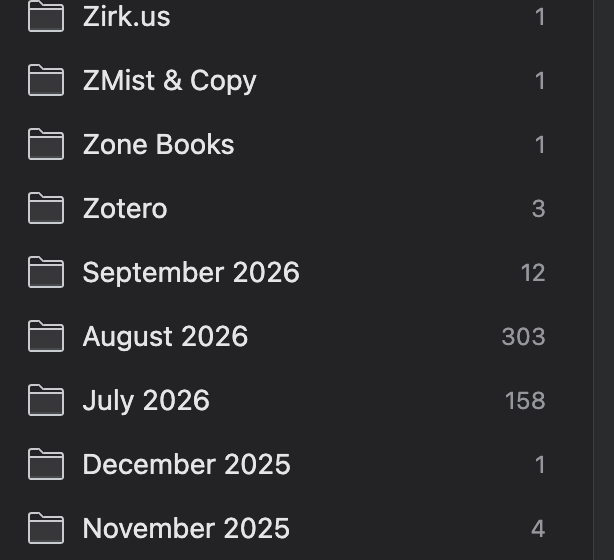
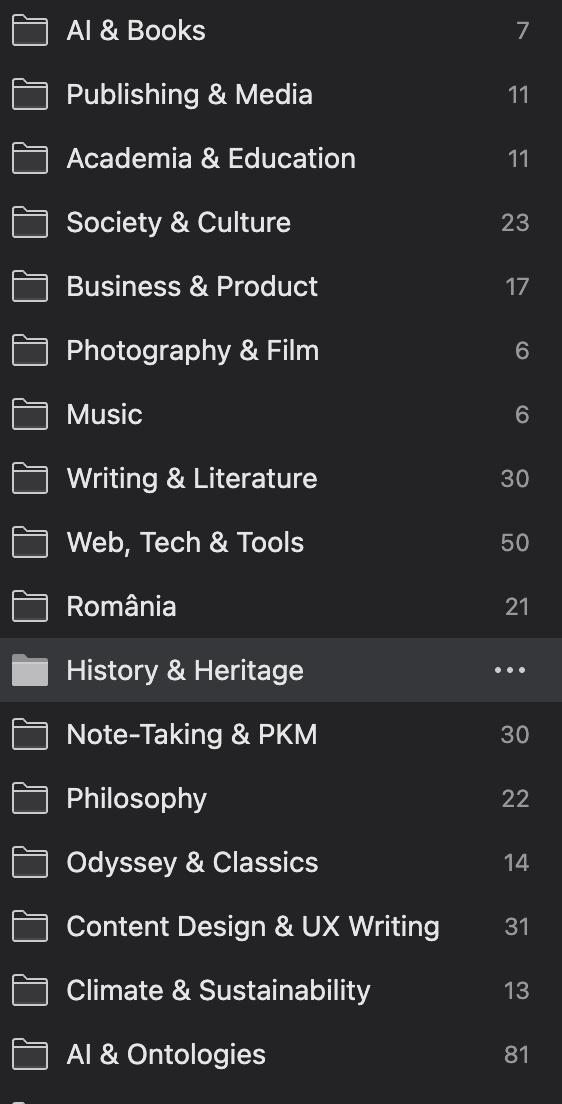
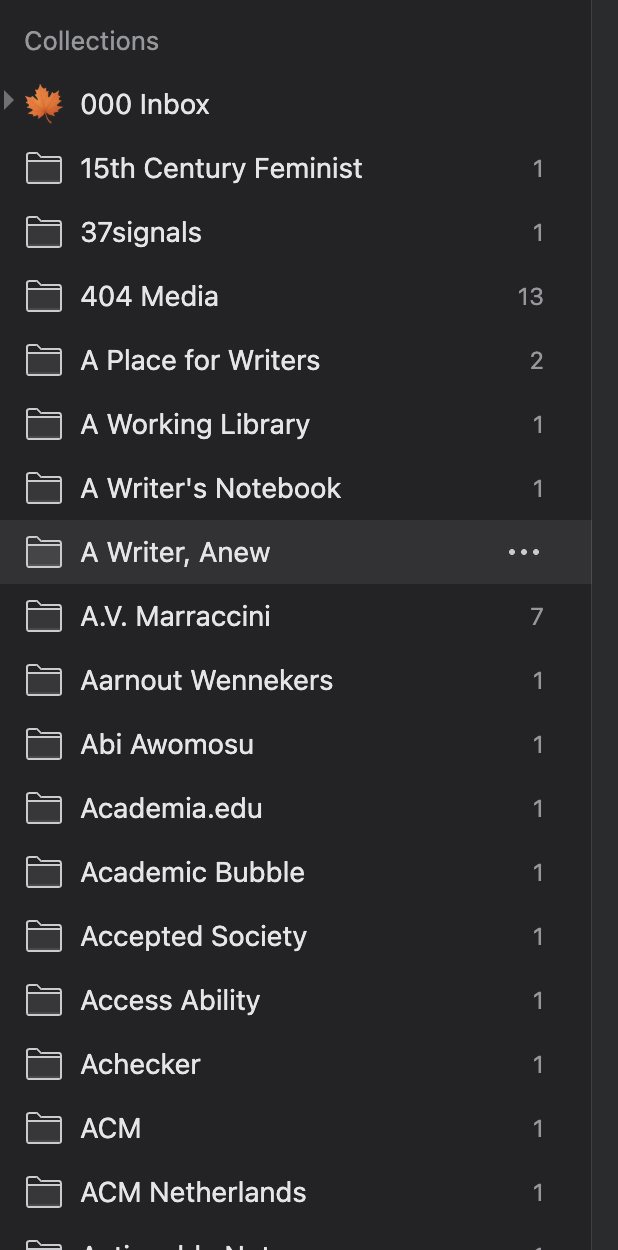
The screenshots below are examples of organisation from my bookmarks manager. The same data is organised based on Time (the left image), based on Category- links with similar topics (central image) and alphabetically (right image).
What to read
W. Patrick McCray, Professor of History at the University of California, writes about the literary history of computers and, more broadly, information technologies from early ideas to current GenAI. From the article:
“Weizenbaum was especially troubled by how programs like ELIZA could easily fool users into thinking they were interacting with a sentient machine. Even more problematic was his sense that people wanted to be deceived. He reserved special reproach for the computer scientists whose work introduced falsehoods into the world.
“One shouldn’t lie,” Weizenbaum once said, an injunction the programmer-turned-critic surely would have directed at contemporary AI researchers and some of their software creations.”
A stunning visual album of Pompeii, including spaces not seen by the public. Created by the Italian photographer Luigi Sina and published by Getty Museum. Link to the book.
What to listen
In the last two weeks, the recordings of Ketil Bjornstad have always been in the background. This week's obsession is Haugtussa, a 2025 album with the women's choir Vokal Vivo. It’s based on the Norwegian poems about the story of Veslemøy, or Haugtussa (‘The Hill Maid’), a young girl haunted by visions, who fights against her demons and nature. Link to Spotify.
What to watch
The fifth and final season of the German drama Babylon Berlin will premiere in Germany on September 10th. Set at the end of the Weimar Republic, it follows a police inspector and a police clerk who wants to become a detective through the final years of the Weimar Republic and the cultural explosion, sexual liberation, and descent into fascism.
Check the Guardian article and interview with the team.
What to use in your work
An excerpt from Umberto Eco’s book How to Write a Thesis via MIT Press. From the article:
- “Begin new paragraphs often. Do so when logically necessary, and when the pace of the text requires it, but the more you do it, the better.
- Write everything that comes into your head, but only in the first draft. You may notice that you get carried away with your inspiration, and you lose track of the center of your topic. In this case, you can remove the parenthetical sentences and the digressions, or you can put each in a note or an appendix. Your thesis exists to prove the hypothesis that you devised at the outset, not to show the breadth of your knowledge.”
Main image via Getty
Tagged
You might also like
-
Can you prove you writing is your own, and it wasn’t AI-generated?

- Written by Daniel Prindii
- Published on
-
Summer reads recommendations
- Written by Daniel Prindii
- Published on
-
How to take notes while reading
- Written by Daniel Prindii
- Published on
-
How to run an independent newsletter
- Written by Daniel Prindii
- Published on
-
On Liquid Content and LLMs
- Written by Daniel Prindii
- Published on


