Miscellanea is the newsletter for the independent thinker, at the intersection of digital content, knowledge management and culture. In this edition, we have a simple guide to blogging and indie web community, history books and an ethereal jazz album.
Edition No 21. Date: 3 November 2026
If you like this newsletter, please forward it to a friend. You can sign up here.
Recently, I went to a book launch of a travel memoir. While talking about the book's evolution, the author said something like, “You can find the first ideas if you scroll 5 years on my Instagram.” And I said to myself: “ I don’t want to scroll on Instagram; I want that to be a blog category and just click it”.
You don’t know you need a blog until you find yourself in similar situations. How often do you share older social posts? How do you find them when they don’t have proper titles? Do you have endless bookmarks in the apps? It’s complicated, right?
So, let’s start a blog. This is the nudge if you are looking for a sign.
Decide on a name and topic
The first decision is to decide if you’re going to blog under your real name or under a nickname. If you go with your name, see if you can connect it to your personal website. If you already have one and the topics are related. But if you want to write something outside professional work, about hobbies or research, create a separate space. Check my earlier article about the importance of personal websites.
Using a nickname will give you more freedom and less pressure. This is the right choice for stream-of-consciousness or culture-critique type of articles.
Decide where you want to publish
When it comes to publishing, every solution has pros and cons.
The independence solution, where you set up almost everything for a blog, is the one where you will have the most control over your data, design, and portability in the future. In this scenario, you’ll need a domain, a hosting service, a content management system, a theme, and to set up an email and add integrations.
The other solution is to choose a service that offers nearly everything as a SaaS( Service as a Software). With platforms like Pika, Bear, or Microblog you create a blog, and they will cover domains, server administration, CMSs and other updates. These platforms are good to test out your writing ideas and get a sense of what a blog means. But they don’t offer the flexibility and don’t have the whole range of integrations of a hosted solution.
I’ll explain each part of a self-hosted solution to show that it’s not complicated, and that the effort put into setting up the system will beat any promises from one-size-fits-all platforms. (Looking at you, Substack and Beehiiv, ha ha).
The domain is how people will find you; it’s the address they will type in any browser. And under this domain name, all technical information will be kept. Next on the list is the hosting, meaning the physical server where the website, emails, etc. will live. On this hosting, you will upload and configure the CMS (content management system, meaning the software that makes your website work), configure the theme, emails, and other things. Think of this as the computer where you’ll find everything related to the blog.
A company like Infomaniak, which I use, offers everything as a simple package. They have an intuitive admin dashboard to manage everything, well-written documentation and responsive customer support.
When it comes to costs: you’ll have the domain (annual price), hosting (annual price), and CMS and theme (can be free or paid).
Most hosted solutions include generous storage sizes, subdomains, and email options, and they will beat, in terms of flexibility and options, the SaaS monthly offerings.
Be part of the indie community
Only writing on the blog is not enough to bring visitors. You need distribution. Because on the web, writing was never the blocker; discovery was.
The easiest way to discover and get discovered is through social platforms. Okay, most of them. The ones that are not taxing you for sharing links: like Mastodon, Bluesky, Eurosky, Tumblr. But social platforms are not the only options. The blogging community has a lot of ways to connect people, ideas, and blogs.
The RSS feed
Make sure your blog has its RSS feed active. RSS is a web standard that offers a direct feed to its content. It's great for following people, news, and discussions. Find a few RSS directories and discovery tools and include your blog. My article on how to start with RSS feeds has a section on discovery tools.
The blogroll
Simply put, the blogroll is a page on your website/blog where you link to other blogs that you recommend. This can be displayed in a sidebar, footer or a page. There is even an ultimate guide to blogrolls, written by CodeCraftWP.
The Slash pages
Slash pages are pages that you add to your website/blog root level and present different topics. These can include: contact page; uses page- to list what you use for blogging, writing, etc.; colophon- to present what software was used to create the blog. You can find them here.
The webrings
A webring is a list of connected blogs that you can visit the next, previous or random blog in the network. You can find a directory of members of the IndieWeb Webring here. Finding other webrings can be a relaxing weekend rabbit hole. You can start here.
In the end, be active
Found something interesting? Share it via social platforms or newsletters. Send it to a friend or two. Talk about it. Write about it. Write to the author to say you like it. Or to disagree agreeably.
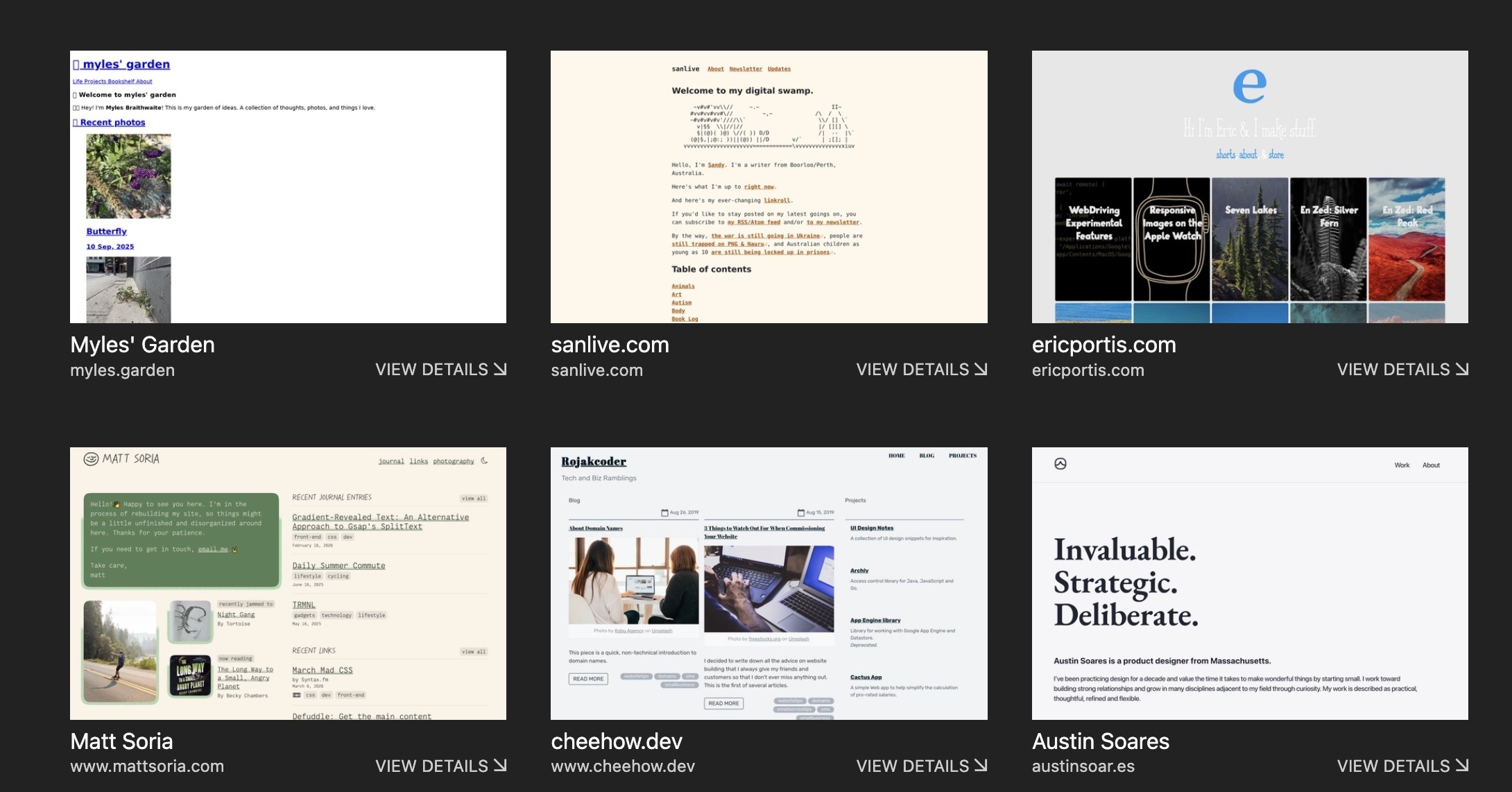
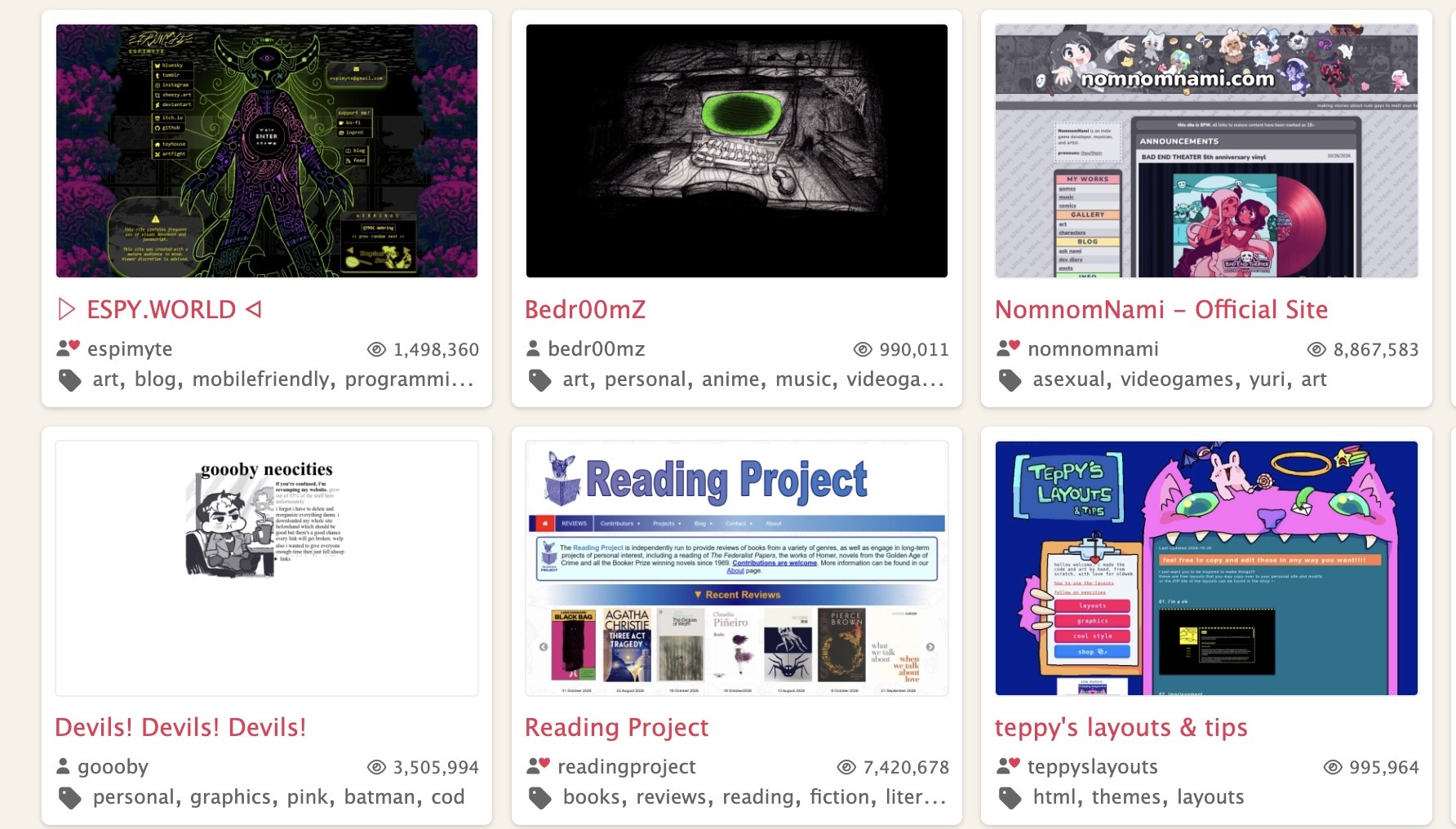
Screenshot of PersonalSite.es blog aggregator (left) and Neocities blog hosting platform (right).
What to read
“Our online spaces are not ecosystems, though tech firms love that word. They’re plantations; highly concentrated and controlled environments, closer kin to the industrial farming of the cattle feedlot or battery chicken farms that madden the creatures trapped within.”
More in Noemamag.
The Wolfson prize is awarded for the best historical writing being produced in the United Kingdom. They published their shortlist for 2026, which include books about pagan gods, Mesopotamia, a history of extinction, and more.
Find it here.
What to listen
Bloom album by Areni Agbabian, published by ECM Records. Soft pianos and an ethereal voice. “Often she is more interested in exploring sound and texture for its own sake.” says John Lewis in The Guardian.
What to use in your work
An index and search engine of open access and public domain images from museums and collection like: Rijksmuseum, Amsterdam, The Metropolitan Museum of Art, Europeana aggregator, and others. You can use them for free in your work.
Find it here.
Main image: Johannes Vermeer. Brieflezende vrouw, ca. 1663. Rijksmuseum, Amsterdam.
Tagged
You might also like
-
Why you should have a personal website

- Written by Daniel Prindii
- Published on
-
Miscellanea no 3: About walled gardens, digital gardens and the Web
- Written by Daniel Prindii
- Published on
-
About participatory culture and where to find it
- Written by Daniel Prindii
- Published on
-
What are third spaces and what makes them work
- Written by Daniel Prindii
- Published on


